Skill-Based Matchmaking in 2026:Is SBMM Getting Better or Worse?
Skill-Based Matchmaking in 2026: Is SBMM Getting Better or Worse? | PlaynixVPN
Meta Title: Skill-Based Matchmaking in 2026: Is SBMM Getting Better or Worse? | PlaynixVPN |
Meta Desc: SBMM is changing every major game in 2026. We break down how matchmaking algorithms work, why lobbies feel unfair, and what the data says across Warzone, Fortnite, and Valorant. |
URL: /sbmm-skill-based-matchmaking-2026 |
Keyword: skill based matchmaking 2026 |
Category: News |
Internal links: → /best-competitive-games-2026 · → /fix-high-ping-valorant
🎮 Gaming News · Analysis
Skill-Based Matchmaking in 2026: Is SBMM Getting Better or Worse?
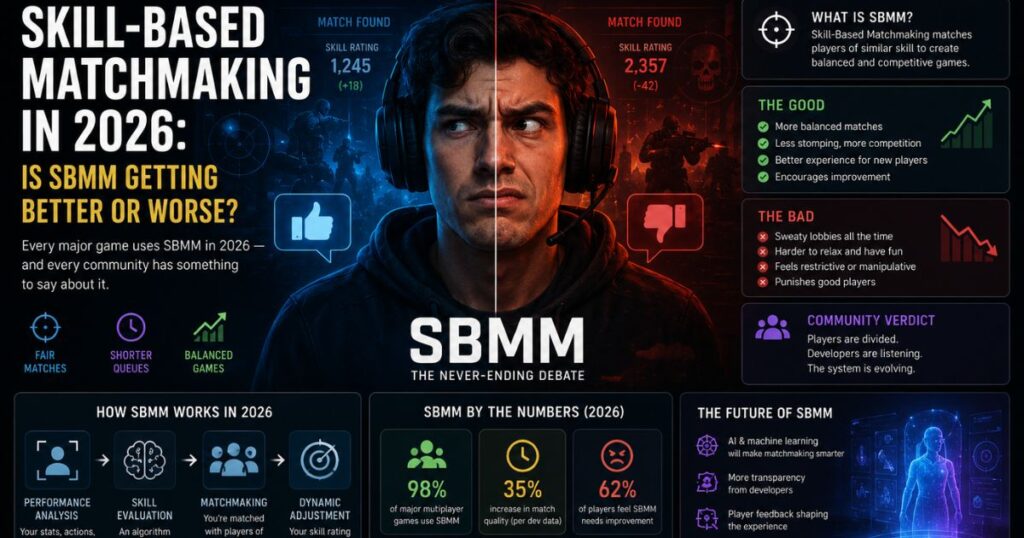
Every major game uses SBMM in 2026 — and every community hates it differently. We break down how matchmaking algorithms actually work, what changed this year, and whether lobbies are becoming more or less fair.
5Games analyzed
2026Algorithm changes
RealPlayer data
📅 May 2026✍️ PlaynixVPN Gaming Team⏱️ 8 min read🎮 News · Analysis
Few topics generate more heat in gaming communities than SBMM — Skill-Based Matchmaking. In 2026, it’s in every major game, it’s increasingly sophisticated, and it’s still misunderstood by most of the people it affects.
This is a factual breakdown. How do modern matchmaking algorithms actually work? What changed in 2026? And based on the available data, is SBMM making competitive gaming more fair or more frustrating?
What SBMM Actually Does (And Doesn’t Do)
📊
How It Calculates Your Skill
Modern SBMM uses rolling performance metrics — K/D ratio, damage dealt, survival time, win percentage — weighted toward your recent 20–50 games. It’s not a single number, it’s a constantly updating performance profile.
⚖️
What It’s Trying to Do
SBMM’s goal is a win probability close to 50% for every player in every match. In theory, this keeps every game competitive. In practice, it creates “engagement-optimized” lobbies that can feel artificially tight.
🔄
The Rubber Band Effect
Strong SBMM creates a rubber band — perform well and your next lobby is harder. Perform poorly and it gets easier. This is intentional. It’s also why “stomping” lobbies is usually short-lived — the algorithm adjusts within 1–3 matches.
⏱️
Queue Time Trade-off
Tighter skill matching = longer queue times. Wider skill matching = faster queues, less fair lobbies. Every SBMM system balances these two factors — and the balance changes by region, time of day, and player population.
SBMM Ratings: Which Game Does It Best in 2026?
Best SBMM
Valorant
9.0
Separate ranked and unranked pools. Transparent visible rank. Performance-based RR clearly communicated. The gold standard for competitive matchmaking in 2026.
Good
CS2 Premier
8.2
Elo-based Premier mode with visible rating. Faceit integration remains the more trusted competitive ladder. CS2 Premier improved significantly in 2025 but smurfing still affects lower ratings.
Mixed
Warzone
6.2
SBMM operates invisibly — no visible rank, no communicated criteria. Casual BR lobbies can swing wildly between pub-stomp and tournament-level. The hidden nature creates distrust.
Mixed
Fortnite
6.5
Arena mode has transparent SBMM. Casual modes use hidden engagement optimization. Zero Build casual lobbies are more forgiving — rated players mixed with unrated creates uneven experiences.
Consistent
Apex Legends
7.8
RP-based ranked mode is one of the most consistent in the BR genre. Placement-heavy scoring rewards survival as well as kills. Still not as transparent as Valorant but clearly communicated.
What Changed in SBMM in 2026
AI-Assisted Skill Profiling
The biggest change in 2026 is the shift from rule-based SBMM to machine learning-driven player profiling. Warzone, Fortnite, and Apex all confirmed moving portions of their matchmaking to ML models in late 2025 or early 2026.
Instead of tracking K/D and win rate alone, these models analyze movement patterns, decision-making in high-pressure moments, aim consistency curves, and positioning heuristics. The result: skill assessments that are harder to game by deliberately performing badly (sandbagging) and more accurate for players with unusual playstyles.
Separate Ranked and Casual Pools
The clearest positive trend of 2026: more games are separating ranked and casual matchmaking pools entirely. Valorant has always done this. CS2 expanded it. In 2026, Apex Legends confirmed dedicated casual servers with wider skill ranges and shorter queue priorities — giving players who just want to unwind a genuinely different experience from ranked.
“The community feedback was clear — people want the option to grind or to chill. A single matchmaking pool can’t serve both goals equally well.”
— Respawn Developer AMA, April 2026
Ping-Weighted Matchmaking
An underreported 2026 development: several games are weighting skill matching against ping proximity. Previously, SBMM would find the closest skill match regardless of their location. Now, algorithms balance skill similarity against server latency — preferring to match players with similar ping to the same server cluster, even if it means a slightly wider skill range.
This is better for everyone. Facing a similarly skilled player at 15ms vs 60ms ping differential is fairer than facing an identical-skill player with a 100ms differential — even in a “perfectly balanced” lobby by skill metrics.
SBMM Changes by Game: 2025 vs 2026
Game
2025 SBMM
2026 Change
Impact
Valorant
Visible rank, perf-based RR
RR history graph added
More transparent
CS2
Elo Premier mode
Anti-smurf detection improved
Cleaner low-rank lobbies
Apex Legends
RP-based ranked
Casual pool separated + ML profiling
Better casual experience
Warzone
Hidden SBMM
Blackout Reborn: optional ranked mode
First transparent ranked option
Fortnite
Hidden casual SBMM
Ping-weighted matching added
Slightly fairer lobbies
The Real Debate: Engagement Optimization vs Fair Play
The core tension in modern SBMM isn’t skill accuracy — it’s the difference between competitive fairness and engagement optimization.
A purely skill-based system finds the most accurate opponent match. But game companies have business incentives to keep players engaged — and research shows players are more likely to keep playing after a narrow loss than after a blowout win or loss. This creates pressure to tune SBMM not just for fairness, but for maximizing session length and return rate.
In practice, this is why casual Warzone lobbies often feel like every opponent is exactly as good as you — even in a 150-player game where pure randomness would create more variety. The algorithm is optimizing for a specific emotional experience: competitive tension.
⚠️ Sandbagging Doesn’t Work Like It Used To
Deliberately playing badly to lower your SBMM rating (“sandbagging”) is increasingly ineffective in 2026 games using ML-based profiling. These systems analyze movement accuracy, decision-making patterns, and aim consistency — not just outcomes. A high-skill player playing badly still moves like a high-skill player, and the algorithm knows it.
SBMM FAQ 2026
That’s SBMM working as designed. When you outperform your current skill bracket, the algorithm updates your profile upward and places you against better opponents to recalibrate. This usually normalizes within 3–5 matches. The effect is more pronounced in games with tight SBMM (Valorant) and less noticeable in games with looser matching (Warzone casual).
In 2026, increasingly yes. Valorant has always weighted server proximity. Fortnite and Apex both added ping-weighting to their matchmaking in 2025–2026. Warzone’s implementation is unknown (hidden algorithm). The practical effect: if you have high ping, the algorithm may match you with other high-ping players rather than finding the skill-optimal match, which can actually feel fairer even if your skill bracket is slightly wider.
Valorant — by a significant margin. Separate ranked and casual pools, visible rank rating, performance-based RR that’s clearly explained, and a ranked system that has been iteratively improved since 2020. If fair matchmaking is your priority, Valorant is the standard every other competitive game is measured against.
Yes. When you party up, most games average the skill ratings across the party and match based on the highest-rated player. So if you’re Silver and your friend is Diamond in Valorant, expect Diamond-level lobbies. This is intentional — it prevents boosting — but it also means casual play with a more skilled friend is noticeably harder. Some games (like Apex) have party-handicap systems to partially compensate for this.
2026 Verdict: SBMM Is Getting Better — Slowly
The trend in 2026 is positive. More games are separating casual and ranked pools, ML-based profiling is reducing sandbagging abuse, and ping-weighted matching is making regional fairness a real consideration. Valorant remains the gold standard, but Apex and CS2 have made meaningful progress.
The engagement optimization tension isn’t going away — games are commercial products and player retention drives decisions. But the competitive scenes for Valorant and CS2 demonstrate that transparent, skill-based matchmaking and commercial success can coexist. Other studios are starting to follow.
Cet article contient des liens d'affiliation. Si vous effectuez un achat via ces liens, nous pouvons percevoir une commission, sans frais supplémentaires pour vous.