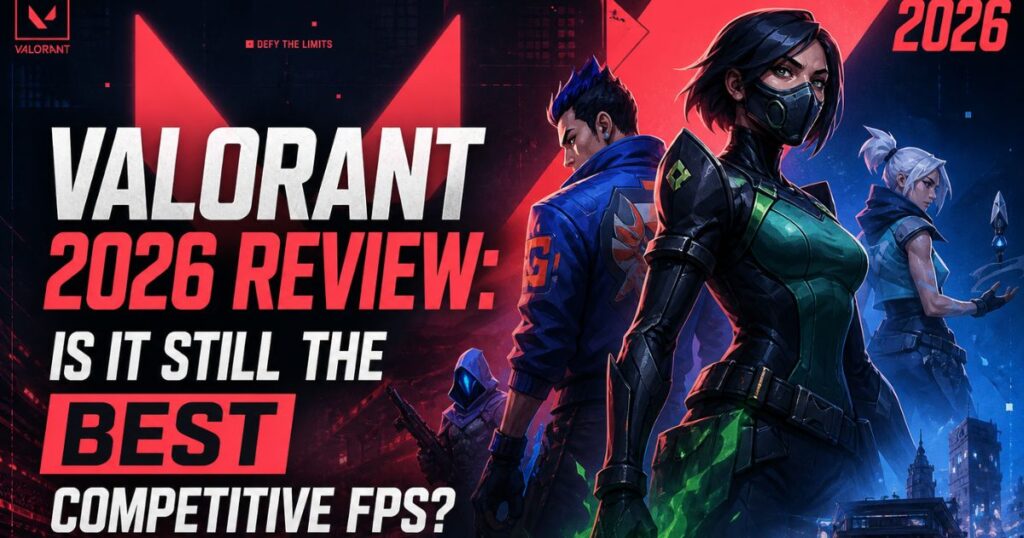
Valorant 2026 Review:
Is It Still the Best Competitive FPS?
Three years in, six episodes, and dozens of agent releases later. We give Valorant a full review in 2026 — covering the rank system, server performance, netcode, and whether it’s still worth your time as a competitive player.
Valorant launched in 2020 with one clear pitch: a tactical shooter with the gunplay precision of CS:GO and the agent variety of Overwatch. In 2026, after three years, dozens of balance patches, and a complete rank rework, it’s fair to ask whether that promise held up.
Short answer: yes. Valorant in 2026 is arguably in its best state. The gunplay is tight, the rank system is the most transparent it’s ever been, and Riot’s server infrastructure remains the gold standard for competitive FPS netcode.
PlaynixVPN Score: Valorant 2026
Server Performance: Still the Best in the Genre
Riot’s server infrastructure in 2026 remains the benchmark for the genre. The dedicated 128-tick servers mean the game processes player positions 128 times per second — registering shots within ~7.8ms of when they actually happened. Combined with server-authoritative netcode, this makes Valorant the most consistently fair shooter in terms of hit registration.
US East Coast players typically see 12–18ms on the New York and Atlanta clusters. West Coast players see 15–25ms on the Los Angeles cluster. Midwestern players routing to Chicago split the difference. These numbers have been consistent through 2025 and into 2026.
The 2026 Rank System: More Transparent Than Ever
Valorant’s rank system has been overhauled significantly since launch. The 2025–2026 update introduced visible Rank Rating history graphs, clearer explanations of RR gains and losses, and reduced the influence of random team performance on individual rank movement for players above Diamond.
The biggest change: performance-based RR bonuses are now more transparent. Winning while performing significantly above your rank’s average gives a visible RR bonus. Losing while outperforming penalizes you less. This makes the grind feel genuinely meritocratic compared to previous seasons.
Gameplay in 2026: Gunplay, Agents & Meta
Gunplay — The Core That Never Gets Old
Valorant’s gunplay model remains largely unchanged from launch — deliberate spray control, precision aim, movement penalties for shooting. This intentional design ages well. The Vandal and Phantom are still the dominant rifles, and the skill gap between mastering one and using it badly is genuinely large and rewarding to close.
The spray-and-pray approach that works in casual games falls apart completely in ranked. This means aim skill is durable — investing time in mechanical fundamentals in Valorant translates directly to rank progression.
Agent Roster — 25+ Agents, Mostly Well-Balanced
The 2026 roster includes 25+ agents across four roles: Duelist, Initiator, Controller, and Sentinel. Riot’s balance team has done a reasonable job keeping most agents viable — the days of single-agent dominance (hello, Chamber) are largely over. The current meta rewards team composition and utility usage more than raw mechanical skill, which has been the consistent design direction since Episode 5.
Map Pool — Improved, Still Evolving
The current competitive map pool features 9 maps. Riot rotates maps seasonally, and community feedback has driven several reworks. Ascent, Haven, and Bind remain fan favorites. Icebox polarizes opinions — its vertical angles create more peeker’s advantage than flatter maps, rewarding lower ping players more noticeably.
US Server Ping Reference by Region
| Your Location | Best Data Center | Avg Ping | Peak Hours | Rating |
|---|---|---|---|---|
| New York / Boston / DC | NA-East (NY) | 8–15ms | 10–18ms | Excellent |
| Los Angeles / SF / Seattle | NA-West (LA) | 12–22ms | 14–26ms | Excellent |
| Chicago / Detroit / Minneapolis | NA-East or Central | 18–30ms | 20–35ms | Good |
| Dallas / Houston / Atlanta | NA-East (ATL) | 22–35ms | 25–40ms | Good |
| Miami / Orlando | NA-East | 30–45ms | 35–50ms | Acceptable |
Valorant 2026: Pros & Cons
- 128-tick servers — best hit reg in the genre
- Free to play with no pay-to-win
- Transparent rank system with visible history
- Excellent US server coverage (NY, LA, ATL)
- Consistent gunplay that rewards skill investment
- Low peeker’s advantage at 128 tick
- Active ranked scene from Iron to Radiant
- Vanguard anti-cheat runs at kernel level (controversial)
- Some agents feel undertuned in the current meta
- Cosmetic pricing is aggressive
- High ping (60ms+) creates noticeable disadvantage
- Ranked matchmaking can feel unbalanced below Platinum
Valorant 2026 FAQ
Verdict: Valorant in 2026 Is Still the One
Three years in, Valorant has earned its position as the most technically sound competitive FPS available in 2026. The 128-tick server infrastructure, transparent ranking, and durable gunplay model make it the best choice for players who want a shooter where skill directly drives rank progression. The agent meta evolves but the core never breaks.
If your ping is holding you back, fix it before grinding rank. Read our guide on reducing Valorant ping to optimize your connection for competitive play.
Fix Your Valorant Ping → Compare All Games →Cet article contient des liens d'affiliation. Si vous effectuez un achat via ces liens, nous pouvons percevoir une commission, sans frais supplémentaires pour vous.