Best Competitive Online Games 2026:
Ranked by Netcode & Performance
Not all online games treat your connection the same. We ranked 2026’s top competitive titles by netcode quality, server tickrate, ping requirements, and how much your connection actually affects the outcome.
You’ve optimized your setup, upgraded your router, and cut your base ping to 18ms. Now the real question: does your game actually use that connection quality, or does it throw it away with bad netcode?
This review ranks the best competitive online games of 2026 by what matters most to connection-conscious players — server tickrate, netcode model, ping tolerance, and how fairly the game handles latency differences between players.
Ping Requirements: What Each Game Type Demands
Full Comparison Table: 2026 Competitive Games
| Game | Tickrate | Netcode | Min Ping (Competitive) | Peeker’s Adv | 2026 Rating |
|---|---|---|---|---|---|
| Valorant 🏆 | 128 tick | Server-auth | <30ms | Low | 9.4/10 |
| CS2 | 128 tick | Server-auth | <30ms | Very Low | 9.2/10 |
| Apex Legends | 60 tick | Server-auth | <50ms | Medium | 8.4/10 |
| Warzone | 60 tick | Server-auth | <60ms | Medium | 7.8/10 |
| Fortnite | 30 tick | Mixed | <70ms | High | 7.2/10 |
| League of Legends | ~30 tick | Server-auth | <80ms | N/A (MOBA) | 8.6/10 |
Individual Game Reviews: Netcode & Network Deep-Dive
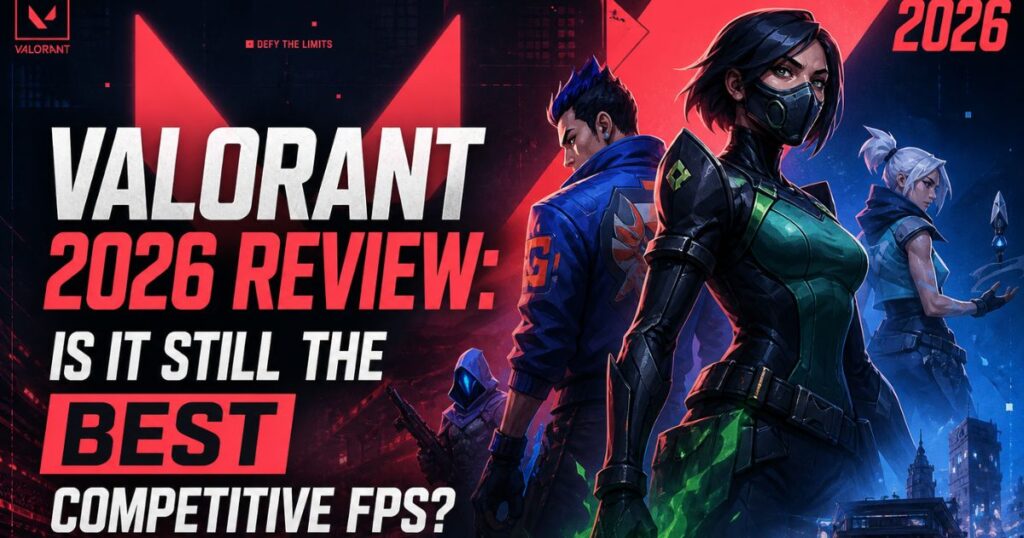
Valorant runs at 128 tick — meaning the server checks positions and registers shots 128 times per second. This is the gold standard for competitive FPS. Combined with Riot’s server-authoritative netcode (the server decides what happens, not the client), it produces the most consistent hit registration of any shooter in 2026.
The game’s netcode actively compensates for latency differences — at under 60ms, Valorant feels fair regardless of whether your opponent is at 10ms or 50ms. Peeker’s advantage is present but minimal at 128 tick. The dedicated NA servers in New York and Los Angeles give most US players 10–30ms baseline ping with a stable connection.
CS2 introduced a sub-tick system that calculates inputs between server ticks rather than waiting for the next tick cycle. In theory, this makes movement and shooting more precise regardless of when your input arrives relative to the server’s update cycle. In practice, it means your clicks register more accurately than in CS:GO.
Hit registration in CS2 in 2026 is the most polished it has ever been after multiple netcode updates. Peeker’s advantage is minimal at Premier rank servers. The dedicated US servers — particularly the Chicago and New York clusters — give most US players under 25ms ping on the East Coast.
Apex Legends runs at 60 tick — half of Valorant — which means positions update less frequently. You’ll notice this more during close-range fights where movement is rapid. That said, Respawn has some of the most advanced movement prediction algorithms in a battle royale, which compensates partially for the lower tickrate.
For US players, Apex’s dedicated server clusters in Oregon and Virginia give solid latency. At 50ms and under, the game feels responsive and skill-expressive. Above 70ms, movement desync becomes noticeable — opponents appear to teleport slightly between server updates.
Warzone’s 60-tick servers are decent for a large-lobby battle royale, but the game’s persistent issue — packet burst — drags down the experience. Packet burst occurs when multiple data packets arrive simultaneously instead of evenly spread, causing micro-stutters that feel like teleporting opponents even at low average ping.
In 2026, Activision has improved packet burst frequency significantly compared to previous seasons, but it remains the biggest connection complaint in the Warzone community. On a wired connection at under 50ms, the game plays well. Above 70ms or on Wi-Fi, the packet burst issue compounds.
Fortnite’s 30-tick servers are the lowest tickrate of any major competitive title in 2026. This means the server updates player positions only 30 times per second — visible in the form of significant peeker’s advantage and occasional hit registration inconsistencies during fast-movement fights.
That said, Fortnite’s casual and competitive scenes are massive and the gunplay is designed around the lower tickrate. Zero Build mode reduced the mechanical complexity, making the netcode less impactful on outcome. If you’re playing Zero Build casually, up to 80ms ping is genuinely playable. Ranked competitive is a different story.
League of Legends occupies a different category. As a MOBA, the pace is slower and the ping requirements are far more forgiving than FPS titles. The game’s netcode is solid for the genre — server-authoritative with low input lag on Riot’s dedicated NA servers in Chicago.
Under 80ms ping, LoL is fully competitive. Skill expression is more about macro decision-making and champion mechanics than raw reaction time, which means connection quality has less impact here than in any FPS on this list. A stable 60ms connection with zero packet loss will let you reach any rank.
FAQ: Competitive Gaming & Connection Quality
Bottom Line: Valorant & CS2 Reward a Good Connection Most
If connection quality matters to you — and it should if you’re playing ranked — Valorant and CS2 are the most rewarding competitive games in 2026. Their 128-tick servers and server-authoritative netcode mean your ping directly correlates to your performance ceiling.
Before blaming the game, make sure your connection is optimized. Check our guide on how to reduce ping in online games for the full network optimization checklist.
Fix Your Valorant Ping → Warzone Lag Guide →Cet article contient des liens d'affiliation. Si vous effectuez un achat via ces liens, nous pouvons percevoir une commission, sans frais supplémentaires pour vous.