AI Anti-Cheat in 2026:The New Arms Race in Competitive Gaming
AI Anti-Cheat in 2026: The New Arms Race in Competitive Gaming | PlaynixVPN
🛡️ Gaming News · Tech
AI Anti-Cheat in 2026: The New Arms Race in Competitive Gaming
For every AI-powered cheat developed in 2026, a studio deploys an AI-powered detection system. We break down the current state of cheating, anti-cheat technology, and which games are actually winning the fight.
4Anti-cheat systems
AIBoth sides now
2026State of play
📅 May 2026✍️ PlaynixVPN Gaming Team⏱️ 7 min read🎮 News · Technology
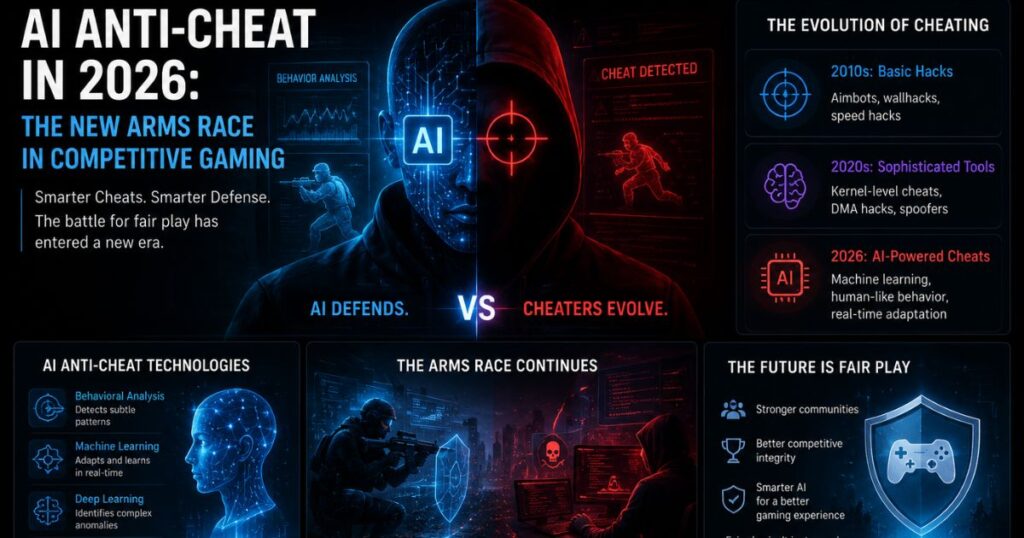
Cheating in competitive games has always been a cat-and-mouse game. In 2026, both sides upgraded to AI. Cheat developers now sell subscription-based AI aimbots that analyze screen pixel data externally — running on a separate device and feeding inputs that are statistically indistinguishable from a human. Anti-cheat systems respond with behavioral ML models that profile every action a player takes over thousands of data points.
This is the current state of the fight. Here’s who’s winning — and where the biggest gaps still are.
How Big Is the Cheating Problem in 2026?
~14%
Estimated cheater rate in unprotected online FPS lobbies globally
<0.5%
Valorant ranked lobbies with active cheaters (Riot 2026 report)
$200+
Monthly cost of premium AI aimbot subscriptions in 2026
4–6h
Average time before a new cheat variant is detected post-ban wave
The raw numbers tell a complicated story. Valorant’s Vanguard system has driven the ranked cheater rate below 0.5% — the lowest of any major competitive shooter. Warzone and Fortnite remain significantly higher, estimated at 3–8% in competitive lobbies according to community tracking data from anti-cheat researchers.
Anti-Cheat System Ratings: 2026
Valorant — Vanguard
Riot Games · Kernel-level · 2020–present
Detection rate
9.6
AI cheats
8.8
False bans
9.5
Best in Class
CS2 — VAC + VAC Live
Valve · Behavioral + kernel · Updated 2025
Detection rate
8.0
AI cheats
7.4
False bans
8.8
Strong · Improving
Warzone — RICOCHET
Activision · Kernel-level · 2021–present
Detection rate
6.8
AI cheats
5.8
False bans
7.5
Mixed — Ongoing issues
Apex — EasyAntiCheat+
Respawn · EAC + Behavioral ML · 2025 update
Detection rate
7.6
AI cheats
7.0
False bans
8.2
Good · Source 2 will help
How Cheating Evolved: 2020 to 2026
2020–2022
Traditional Aimbots & Wallhacks
Memory-reading cheats that directly access game data. Detectable by kernel anti-cheat through signature scanning. Most major studios deployed kernel-level detection in this period.
2022–2024
Driver-Level Exploits
Cheats moved to custom hardware (FPGA devices, modified mice firmware) and driver-level exploits to bypass kernel anti-cheat. Significantly harder to detect — required behavioral analysis to catch.
2024–2025
External AI Aimbots (Screen-Reading)
AI models running on a second PC analyze the game’s screen output via capture card and inject inputs through HID devices. Completely external — the game process sees only legitimate mouse inputs. Hardest category to detect.
2025–2026
AI vs AI: Behavioral Detection
Anti-cheat teams deploy behavioral ML models trained on millions of legitimate player profiles. The goal: detect statistical patterns in movement, flicks, tracking, and decision-making that no human produces — even external AI aimbots leave behavioral signatures different from organic play.
How AI Anti-Cheat Actually Works in 2026
Behavioral Profiling at Scale
Modern AI anti-cheat doesn’t scan your game files — it watches how you play. Every mouse movement, every flick, every pixel-level aim adjustment is tracked and compared against a model trained on billions of data points from verified legitimate players.
The key insight: AI aimbots move differently from humans, even when designed to mimic human behavior. The micro-corrections an AI makes to track a moving target follow mathematical patterns that are statistically inconsistent with organic motor control. Vanguard’s behavioral model looks for these signatures across entire match histories, not single suspicious moments.
Why Valorant’s Vanguard Leads
Vanguard runs at kernel level (Ring 0) — the deepest level of system access, the same level that Windows core processes run at. This means it can monitor hardware inputs, detect driver-level spoofing, and observe system calls that user-level anti-cheat can’t see. Combined with Riot’s behavioral ML system that monitors play patterns across ranked history, it creates the most comprehensive detection stack in any consumer game.
💡 Why Vanguard Is Controversial
Kernel-level anti-cheat is effective — but it requires trusting Riot with deep system access that persists even when Valorant isn’t running. Some players disable it when not gaming for privacy reasons. Riot maintains that Vanguard doesn’t collect personal data, but the requirement for Ring 0 access on an always-on basis is a legitimate security concern worth understanding.
The External AI Aimbot Problem
The hardest cheat category to combat in 2026: external AI aimbots using screen capture. These run on a completely separate computer, analyze the game screen through HDMI capture, and send mouse inputs through a hardware emulator. The game process never sees any suspicious activity — because there isn’t any from the game’s perspective.
Detection requires behavioral analysis alone — and premium external AI aimbots in 2026 are specifically tuned to mimic human behavioral patterns, introducing artificial micro-jitter, randomized reaction times, and miss rates to avoid detection. It’s an AI arms race in the truest sense.
Anti-Cheat Comparison: Key Facts 2026
Game
System
Level
AI Detection
Cheater Rate (est)
Verdict
Valorant
Vanguard
Kernel (Ring 0)
Yes — behavioral ML
<0.5%
Best in class
CS2
VAC + VAC Live
Kernel + cloud
Partial — improving
1–3%
Strong, not perfect
Apex Legends
EasyAntiCheat+
Kernel + behavioral
Yes — 2025 update
2–4%
Good — improving
Warzone
RICOCHET
Kernel
Limited behavioral
4–8%
Underperforming
Fortnite
Easy Anti-Cheat
User + kernel
Basic
5–10% (casual)
Weakest major game
⚠️ Warzone’s Ongoing Problem
RICOCHET has blocked over 350,000 accounts in 2025–2026, but the cheater rate in Warzone competitive lobbies remains significantly higher than Valorant. The core issue: Warzone’s larger, faster-moving lobbies make behavioral analysis harder — a player can play 10 legitimate matches for every cheating match, creating a lower signal-to-noise ratio for detection.
Anti-Cheat FAQ 2026
Valorant. Riot’s Vanguard system, combined with behavioral ML analysis and a kernel-level implementation, keeps the ranked cheater rate below 0.5% — the lowest of any major competitive shooter. CS2’s VAC Live is a strong second, particularly in the Premier competitive mode. Warzone and Fortnite remain the most affected by cheaters in casual lobbies.
External AI aimbots (screen-reading on a second PC) can bypass kernel-level file scanning — because there’s nothing to scan in the game process. However, they can’t bypass behavioral analysis. The best external AI aimbots in 2026 are specifically engineered to mimic human behavioral patterns, but Vanguard’s ML model has been trained on enough data to detect statistical anomalies even in well-designed external cheats. It’s an ongoing arms race — neither side has a permanent winning solution.
Kernel-level anti-cheat from established studios (Riot’s Vanguard, Activision’s RICOCHET) has a reasonable security track record — no major data breaches or system compromises attributed to these systems. The concern is theoretical: kernel access means a vulnerability in the anti-cheat software could theoretically be exploited. Riot and Activision have security teams specifically hardening these systems. The privacy concern (persistent monitoring even when the game isn’t running) is more legitimate — check each system’s documentation for specifics.
No — and studios know this. The goal is raising the cost and sophistication required to cheat until it’s inaccessible to casual cheaters and financially unviable for most professional cheat developers. In Valorant, that cost is now high enough that the ranked player pool is genuinely clean. That’s the realistic ceiling: not zero cheaters, but a population low enough that most players never encounter one in their ranked sessions.
2026 Anti-Cheat: Progress Is Real, But Uneven
Valorant’s Vanguard represents what’s possible when a studio commits fully to anti-cheat infrastructure — a sub-0.5% cheater rate in ranked play. CS2 and Apex are moving in the right direction with behavioral ML additions. Warzone and Fortnite have the most ground to cover.
The external AI aimbot problem isn’t solved — it’s being contained. As behavioral analysis models improve and developers share detection research, the advantage will continue to narrow. For now, the cleanest competitive experience in 2026 is still in Valorant’s ranked mode. Want to optimize your actual connection performance? Check our full Valorant 2026 review for server and netcode analysis.
Cet article contient des liens d'affiliation. Si vous effectuez un achat via ces liens, nous pouvons percevoir une commission, sans frais supplémentaires pour vous.